

Prefabricated control cabinets are a fundamental component of industrial automation systems and electrical installations used in various types of warehouses and manufacturing facilities, where integration of multiple devices is required.
This article discusses what control cabinet prefabrication is, how the entire process works, and what benefits well-built control cabinets provide.
Control cabinets prefabrication – definition and practical use
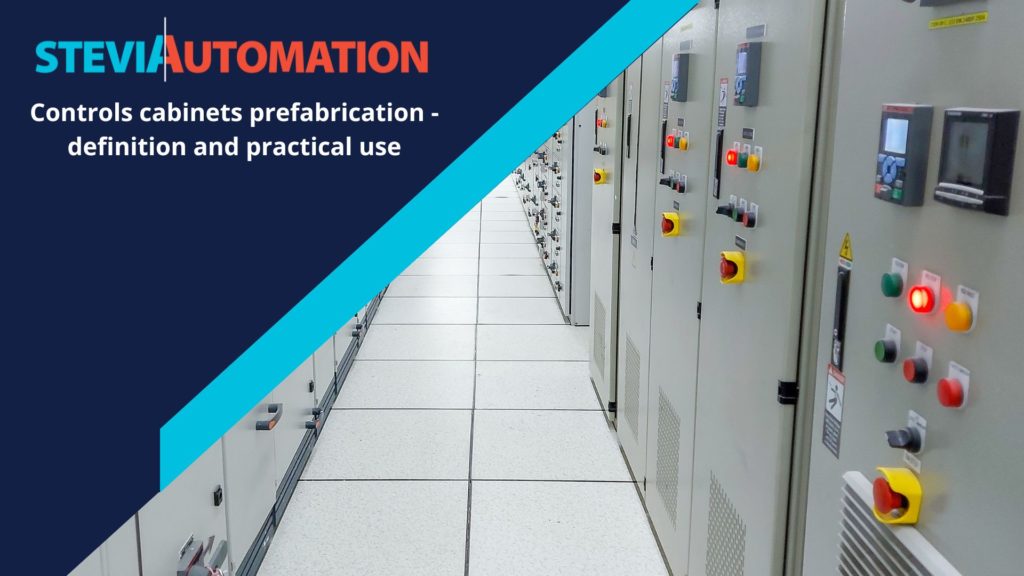
What is control cabinet prefabrication?
Control cabinet prefabrication involves designing, creating a bill of materials, assembling all necessary components, and mounting them according to an electrical or automation schematic. Once completed, the cabinet is typically shipped to its destination site for connection and commissioning. The foundation of this process is the prior purchase and preparation of all constituent parts – such as the enclosure, mounting plate, wiring, and electronic components – followed by their assembly using specialized tools. This approach enables the creation of high-quality installations and minimizes errors during on-site commissioning.
What does a prefabricated control cabinet consist of?
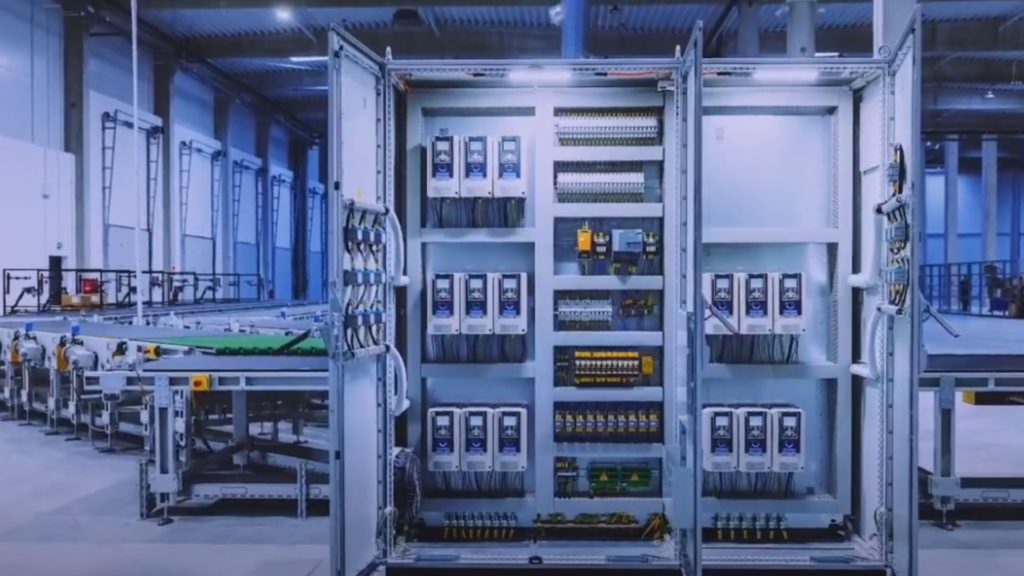
A prefabricated control cabinet includes many components that perform different roles but work closely together. The most important ones are:
- PLC controllers – responsible for executing control logic and automation algorithms,
- HMI panels – enable operator interaction with the system, monitoring process status, and adjusting parameters,
- Controllers and monitoring sensors – provide information about system conditions and send signals to PLCs or higher-level systems,
- Signaling systems – indicator lights, sirens, or other warning devices that alert operators to alarm or exceptional conditions,
- Protection devices – circuit breakers, fuses, and explosion-proof systems protecting electronic circuits,
- Enclosure and mechanical structure – load-bearing elements, ventilation, seals, mounting plate, and the overall framework ensuring proper working conditions.
Each of these components must be selected to meet the technical, environmental, and regulatory requirements of the specific project.
Advantages of control cabinet prefabrication
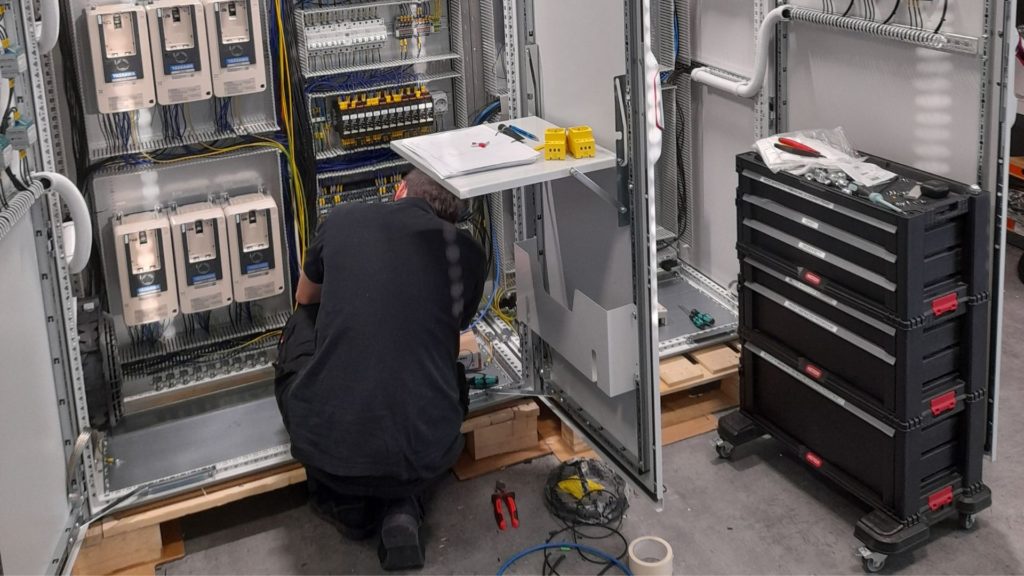
The prefabrication of control cabinets offers a range of benefits that directly impact the quality, reliability, and efficiency of implemented projects. By preparing the cabinets in controlled workshop conditions, it is possible to maintain high assembly precision, compliance with documentation, and adherence to applicable standards. An important aspect is also the workmanship quality – including cable routing methods and the arrangement of installed components – ensuring that every element is correctly labeled and the cabinet presents a neat, professional appearance.
The prefabrication process minimizes the risk of errors during commissioning, reduces on-site installation time, and enables early functional testing of the system. Another advantage is the standardization of solutions, which simplifies future maintenance, upgrades, and ensures consistent quality across all implemented installations.
The process also guarantees safety and compliance with current regulations. Control cabinets must meet European standards, including PN-EN 61439, as well as requirements related to low-voltage and machinery directives.
Step-by-Step process of control cabinet prefabrication
Prefabrication is not limited to manufacturing raw components or merely assembling the cabinet – it is a multi-stage process that requires precision and coordination. At the initial stage, project requirements are defined, covering system functionality, connected devices, environmental conditions, and applicable standards. Data on the number of load points, power supply parameters, and safety requirements are collected.
Once all project details are determined, electrical diagrams, bills of materials, technical drawings, and 3D models are created. This documentation ensures the project’s completeness and helps prevent assembly errors.
Next comes the assembly phase, which includes mechanical mounting of components, wiring, and integration of controllers, sensors, and protective devices – all performed according to the design documentation. After installation, the cabinet undergoes a series of electrical, functional, and environmental tests. These verify connection continuity, correct operation of safety systems, and the response of the control logic to simulated input signals. If all tests are successfully completed, the cabinet is delivered and installed at the end user’s site. It is connected to the power supply and the field devices, followed by final commissioning tests under real operating conditions.
Once commissioned, the maintenance cycle begins. Depending on the service agreement, this may include periodic inspections, measurements, cleaning, software updates, and replacement of components subject to wear during operation.
Applications of control cabinet prefabrication
Prefabricated control cabinets are widely used in workplaces where industrial automation systems are implemented. They form an integral part of modern production and infrastructure solutions, ensuring safe and reliable operation of automated systems.
- Intralogistics – control cabinets are an essential part of every internal transport or sorting system, providing continuous control and supervision over system operation.
- Manufacturing industry – in production plants, they are responsible for machine control, process optimization, and the integration of technological lines.
- Building automation – in HVAC management systems, they control lighting, power supply, safety, and smart building integration functions.
- Energy and water infrastructure – used for managing the operation of pumps, transformer stations, water treatment facilities, and wastewater treatment plants.
- Explosion-Hazard zones (Ex Zones) – in industrial installations within chemical, refinery, and petrochemical sectors, equipped with certified components designed for operation in explosive atmospheres in compliance with the ATEX directive.
Each of these components must be selected to meet the technical, environmental, and regulatory requirements of the specific project.
Benefits of control cabinet prefabrication
Control cabinet prefabrication is an advanced process that enables the creation of solutions tailored to client needs and the highest technical requirements. The integrated process – from analysis, through design and assembly, to testing and maintenance – ensures execution consistency, reduces implementation time, and increases overall system reliability. Carefully prefabricated control cabinets are suitable for all applications where safety, continuity of operation, and compliance with standards are critical — in industry, infrastructure, and high-risk environments.