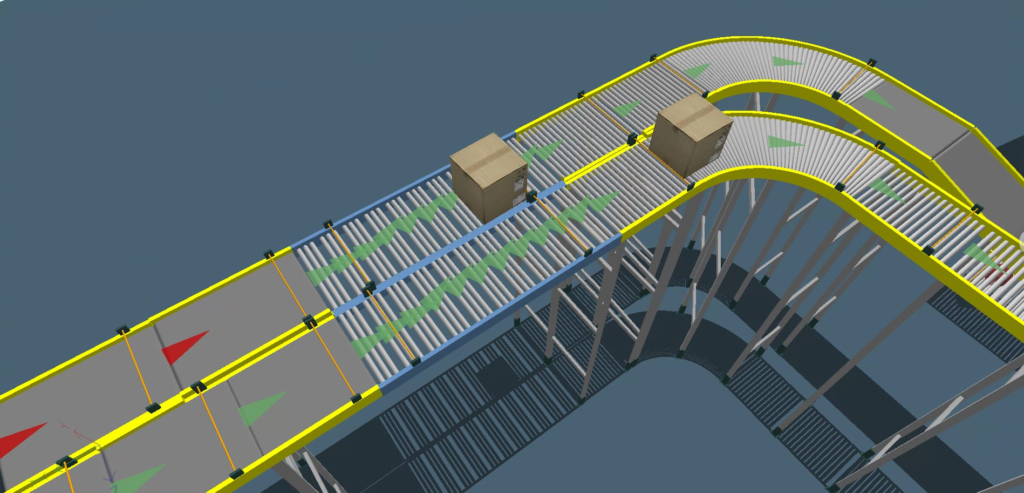

The main task of PLCs is to control the flow of products on industrial lines. However, control alone is not enough, as each product must be sent to a specific destination. Communication between controllers and higher-order systems, which determine the flow path of the product, is crucial in this regard.
Integration with IT systems
To determine the product route, the control system scans the barcode or reads the RFID code. The information is then sent by the controller to the higher-order system (WMS), which returns information about the product’s destination. PLCs track each product, delivering it through the conveyor system to its destination.
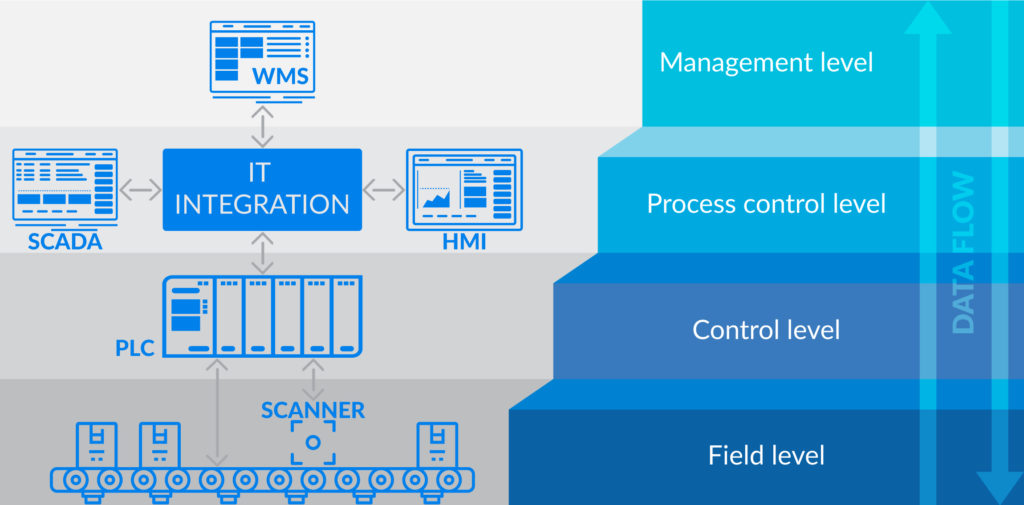
What you gain from integration:

Communication with the WMS master system

Fully automated product flow

Dynamic destination definition

Confirmation of product arrival at destination
Stevia Control Standard – efficient integration of automation with IT systems
Within our SCS (Stevia Control Standard), we use dedicated function blocks that enable communication between PLC controllers and higher-level IT systems. When integrating IT systems with automation, we adapt our software blocks to the specific data exchange methods provided by the client’s systems. Most commonly, we use TCP/IP telegram-based communication over the network.
Depending on project requirements, we can also deliver more advanced IT integration by developing an intermediary system that acts as a connector between two environments: the client’s WMS system and the control system.
Integration of automation with IT systems
IT systems play a key role in modern industry and must be integrated with automation equipment. Continuous and fast communication between automation and IT systems enables precise execution of internal transport and synchronization of production and warehouse processes. By utilizing multiple cameras and sensors within the automation system, and after proper integration, operators in the WMS system can track the location of each product in real time.
We provide full integration of automation with IT systems, enabling efficient management of intralogistics operations and contributing to the reduction of material handling costs. Advanced intralogistics IT systems combined with automation increase overall facility efficiency and minimize the risk of human error.